Metronome by Lorànt Deutsch
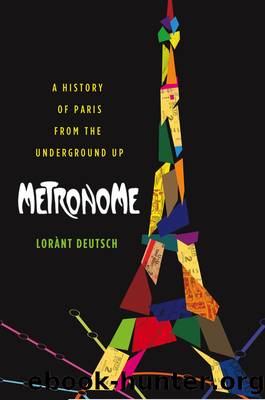
Author:Lorànt Deutsch
Language: eng
Format: epub
Publisher: St. Martin’s Press
Eleventh Century
Arts et Métiers
The Millennium Myth
The Arts et Métiers Métro stop is very handsome indeed. In fact it looks like it figures in a Jules Verne story, the Art Nouveau copperwork making it seem like something a mad scientist might come up with—a vessel to take us on a long voyage not only to some other place, but to some other time.
This is all a daydream, of course, because this ship doesn’t actually move; to get anywhere on it you have to get on the antique wood escalator, heading down one side and coming up the other, then repeating the operation. You will find yourself going round and round the Conservatoire National des arts et métiers on Rue Saint-Martin.
Until the Revolution, this stop is where the Saint-Martin-des-Champs priory had stood, a small oratory that had been constructed on the very spot where Saint Martin had kissed and cured a leper. The chapel was torn down in the eleventh century and replaced by a large monastery, which could be found on what are today the streets Saint-Martin, Vertbois, Montgolfier, and Bailly.
But let us return to the year 1000. It is an imposingly round number, to be sure. Nonetheless, millennialism did not seem greatly to disturb the thoughts of the realm’s inhabitants, although in certain Parisian churches somber-faced abbots proclaimed the imminent arrival of the Antichrist. These men were opposed by clear-thinking theologians who denounced such superstitious beliefs and assured their flocks that no one on earth could predict the end of the world.
In short, the year 1000 was not a doom-and-gloom moment. The notion of the medieval millennium was popularized in the nineteenth century by romantics and historians such as Jules Michelet, who viewed Christianity in the Middle Ages as a time of fervor and passion, a seething caldron of emotion.
With or without fear of the Apocalypse, the year 1000 was nonetheless part of a period dominated by the Church. Supported by the faith of its adherents, the pontifical seat gained enough momentum to reform practices that it deemed unworthy. Until then, it must be said, the Church had been completely integrated into the feudal system: the sacred and the profane intermixed; the preoccupations of the bishop were the same as those of the aristocracy, at least in terms of the governance of the land, the system of earnings, and the collection of taxes and duties. At bottom the spiritual and the temporal were one and the same. A more serious problem from the Church’s viewpoint was that some ecclesiastical functions were being monopolized by aristocrats, who didn’t necessarily have the ecumenical training but who nonetheless considered religious titles hereditary, to be handed down father to (eldest) son.
For Rome and all true Christians, the time had come to purge the Church of its abuses and rediscover the way to God. Rome would not be the plaything of barons and lords. Render unto the Lord what is the Lord’s.
This renewal started at Cluny, the Benedictine abbey in Burgundy that sought to release itself of all temporal domination and be placed under the sole authority of the pope.
Download
This site does not store any files on its server. We only index and link to content provided by other sites. Please contact the content providers to delete copyright contents if any and email us, we'll remove relevant links or contents immediately.
The Goal (Off-Campus #4) by Elle Kennedy(13627)
Kathy Andrews Collection by Kathy Andrews(11777)
Diary of a Player by Brad Paisley(7531)
What Does This Button Do? by Bruce Dickinson(6176)
Assassin’s Fate by Robin Hobb(6173)
Big Little Lies by Liane Moriarty(5759)
Altered Sensations by David Pantalony(5080)
Pale Blue Dot by Carl Sagan(4969)
Sticky Fingers by Joe Hagan(4156)
The Death of the Heart by Elizabeth Bowen(3589)
The Heroin Diaries by Nikki Sixx(3525)
Beneath These Shadows by Meghan March(3285)
Confessions of a Video Vixen by Karrine Steffans(3283)
How Music Works by David Byrne(3239)
The Help by Kathryn Stockett(3127)
Jam by Jam (epub)(3060)
Harry Potter 4 - Harry Potter and The Goblet of Fire by J.K.Rowling(3038)
Computational Linguistics and Intelligent Text Processing: 20th International Conference, CICLing 2019 La Rochelle, France, April 7â13, 2019 Revised Selected Papers, Part I by Alexander Gelbukh(2968)
Strange Fascination: David Bowie: The Definitive Story by David Buckley(2844)
